Kabul
Information Kabul
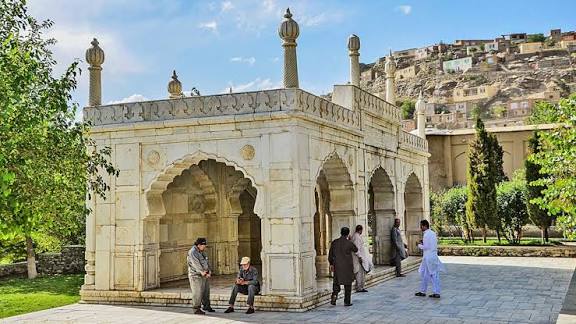
1. Babur Shah Garden:
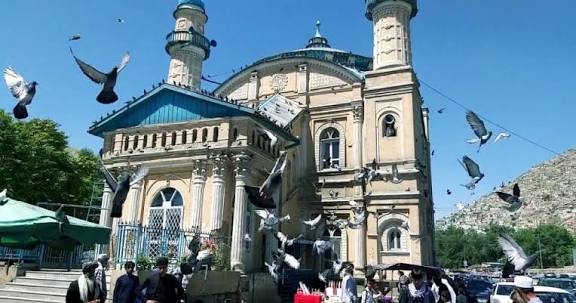
4. Shah-Do Shamshira Mosque:
Bagh-e- Babur (Dari: باغ بابر), also known as Gardens of Babur, is a historic site in Chelsatun, Kabul, Afghanistan.
The garden of Babur has several terraced buildings, a small mosque, and plenty of walking space.
Visited by up to one million locals and foreign tourists a year, it is also where the tomb of the first Mughal emperor Babur is located.
Since Babur had such a high rank, he would have been buried in a site that befitted him. The garden where it is believed Babur requested to be buried is known as Bagh-e Babur.
Mughal rulers saw this site as significant and aided in the further development of the site and other tombs in Kabul.
2. Darul Aman Palace:
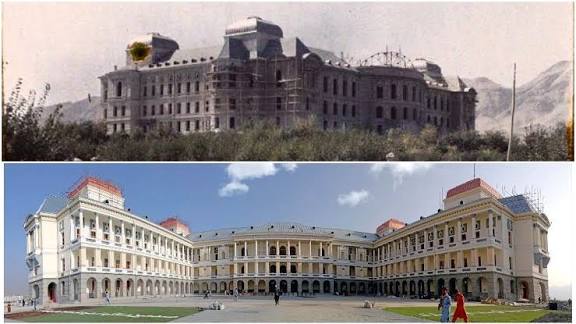
Darul Aman means: The Palace of Amanullah. Construction of the Darul Aman Palace began in the early 1920s as part of the endeavours of Emir Amanullah Khan to modernise Afghanistan.
In June 1926, Amanullah proclaimed himself as King of Afghanistan. The palace was to be part of the new capital city called Darulaman,Amanullah Khan invited 22 architects from Germany and France to build the palace with a three-story palace and 150-Rooms.
Much of the building was damaged by tank fire during war in Afghanistan against Russian.
However, between 2016 and 2020, the palace was renovated and restored to its former glory.
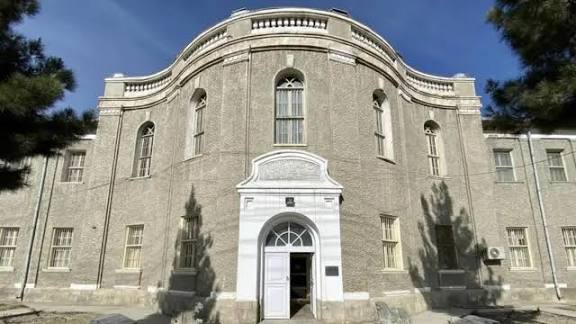
3. The National Museum of Afghanistan:
The National Museum of Afghanistan is located across the street from the Darul Aman Palace in the Darulaman area of Kabul, Afghanistan.The Afghan National Museum was opened in 1919 during the reign of King Amanullah Khan.
After the collapse of President Mohammad Najibullah's government and the start of a civil war in the early 1990s, the museum was looted numerous times, resulting in the loss of 70% of the 100,000 objects which were then on display.
A rocket attack in May 1993 buried ancient potteries under debris.
In March 1994, the museum, which had been used as a military base, was struck by rocket fire and largely destroyed.
in 1989, the Bactrian Gold had been moved to an underground vault at the Central Bank of Afghanistan.
In February and March 2001, the Taliban destroyed countless pieces of art due to religious reasons. It was reported in November 2001 that the Taliban had destroyed at least 2,750 ancient works of art during the year.
Since 2007, UNESCO and Interpol have helped to recover over 8,000 artefacts, the most recent being a limestone sculpture from Germany. and 843 artefacts returned by the British Museum in July 2012.
Shah-Do Shamshira Mosque means in English (Mosque of the King of Two Swords), is a yellow two-story mosque in Kabul, Afghanistan just off the Kabul River and the Shah-Do Shamshira bridge in the center of the city.
The Shah-e Doh Shamshira Mosque, also known as the "Mosque of the King of Two Swords," is named after a legend about an Arab general who, after being beheaded in battle, continued to fight with two swords, leading his army to victory.
This general is believed to have died during the early Islamic conquests when Arab forces attacked Kabulistan.
The mosque's name refers to an Arab general, often identified as Laith Ibn Qays. Despite being killed, the legend says he continued to fight, wielding two swords, and inspired his troops to victory.
It was rebuilt during the reign of Amanullah Khan (1919–1929) It was modelled after the Ortaköy Mosque in Istanbul.
Murad Khani Street (Old Kabul):
Murad Khani is a historic neighborhood in the Old City of Kabul, Afghanistan, recognized as a culturally significant area. It was named after two Murads and was developed in the 18th century on a traditional Islamic pattern around a mosque and a bazaar.
This street is 300 years old.
Why this street is called Murad khani?
Murad khan was a tribe. Murad Khane was named after two Murad Khans: one the brother of a 17th-century Mughal governor and the second an 18th-century general.The area was ruined due to several wars but developed in the 18th century by Ahmad Shah Durrani, the founder of the Durrani Empire.
Murad khane tribe belongs to the Qizilbash or Kizilbash were a diverse array of mainly Turkoman Shia militant groups that flourished in Azerbaijan, Anatolia, the Armenian highlands, the Caucasus (Kafqaz) from the late 15th century onwards.
Murad Khane retains much of its original fabric with a network of small streets connecting the bazaar, religious structures, caravanserai and houses in a layout that represents the area's unique ties to Islamic design and nearly four hundred years of Afghan history.
It is one of the few surviving historic commercial and residential neighbourhoods in Kabul.
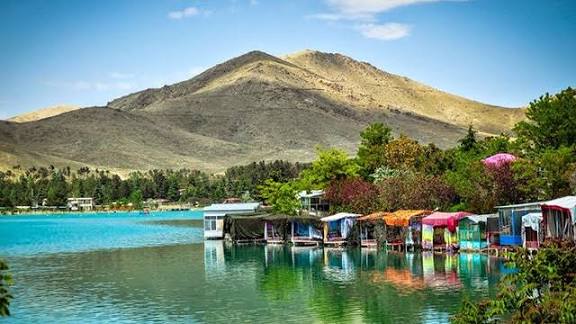
5. Qargha Lake Reservoir (Dam):
Qargha Dam is located in the town of Qargha, It is an embankment dam built on the Paghman River, Its reservoir can hold up to 12,000,000 m3 (420,000,000 cu ft) of water, which is used for irrigation purposes. The dam is named after the town.
Qargha Dam was built in the 1930s under King Mohammad Nadir Shah and his son Mohammad Zahir Shah, mainly for irrigation and tourism purposes. It has since been a popular picnic location, particularly on the weekends and public holidays when it is visited by a large number of picnickers.
6. Paghman:
Paghman is a town in the hills near Afghanistan's capital of Kabul. It is the seat of the Paghman District (in the western part of Kabul Province) which has a population of about 120,000.
The gardens of Paghman are a major tourist attraction, and the reason for the city being known as the garden capital of Afghanistan. The neighboring town of Qargha is to the southeast, which can be reached by several roads.
After King Amanullah Khan and Queen Soraya Tarzi's return from Europe in 1928, Amanullah brought in foreign experts to redesign Kabul. At that time, at the entrance of Paghman, they created a European-style monumental gate similar to but smaller than the Arc de Triomphe in Paris, France, which was similarly called the Taq-e Zafar.
The new royal gardens were opened to the public, but people had to wear Western-style clothing there, just like in the royal areas of Kabul. On September 1, 1928, King Amanullah held a meeting of the Loya Jirga (grand assembly) in Paghman. Many delegates were confused and uncomfortable with the dress rule.
On September 7, 1928, a religious leader from Kabul, the Hazrat of Shor Bazaar, gave the king a petition signed by about 400 religious leaders who opposed the king’s reforms.
As a result, the Hazrat was arrested, some of his followers were executed, and a rebellion broke out in 1929. It was led by Ameer Habibullah Kalakani and ended with the king being overthrown.
During the Soviet–Afghan War in the 1980s, Paghman was a major battleground and suffered from bombardment from both the Soviet-backed government and the mujahideen rebels. Most buildings were destroyed and residents had fled. Little remained of the prosperous Gardens, save for the remains of the Arc de Triomphe style arch, which has had its top blown off.
Following the formation of the Karzai administration, the Arch was reconstructed and was completed by May 2005. Other damaged parts of the former Gardens were also rebuilt.
In 2014, a newly built palace, the Paghman Hill Castle, was opened to the public. The palace's surroundings also consists of thousands of newly planted trees as well as a Buzkashi field, a waterfall and other attractions. The palace's interior is decorated with traditional handmade Afghan carpets and other traditional material.
It was planned to be used for major festivals.
7. Poli Kheshti Mosque:
Pul-e Khishti Mosque is the largest mosque in Kabul, Afghanistan. Located in the center of old Kabul, the Pul-e Khishti Mosque can be identified by its large blue dome.
The mosque originally was built in the late 18th century, which is 300 years old. but was largely rebuilt under Zahir Shah in the late 1960s. It was damaged during fighting in the 1990s, but has been fully restored as of 2019.
Many Kabulis assert that the imam of this mosque for many years in the early part of the 20th century was an Englishman who had converted to Islam, and that the imam returned to England after left his position at the mosque.
8. Old Kabul Bird’s Street:
It's a narrow lane tucked away behind the Pul-e Khishti Mosque, lined with stalls and booths selling birds by the dozen, plus the occasional rabbit. It is also called Kocha -e- Kaa frooshi.
Most of the birds come from Afghanistan, caught in the wild or raised. Some are imported from neighboring countries, such as Iran and Pakistan.
It's a narrow lane tucked away behind the Pul-e Khishti Mosque, lined with stalls and booths selling birds by the dozen, plus the occasional rabbit. It is also called Kocha -e- Kaa frooshi.
Chihil Sutun Garden:
Chihil Sutun meaning ("Forty Columns"), also spelled Chehel Sutoon, Chelsutoon, Chehelseton or Chihilsitoon, is a historic palace with gardens located about 3.6 kilometres (2.2 mi) east of Darulaman neighborhood in Kabul, Afghanistan. It was built in 1796 by Emperor Zaman Shah Durrani. The palace and neighborhood are part of District 7 of the city.
Chihilsitoon is located on the outskirts of the city's urban area, just east from the Kabul River that streams south towards Char Asiab. The Chihilsitoon Road links it towards central Kabul to the north and Darulaman to the west. Like other places of District 7, it is an unplanned area and generally poor.
Chihilsitoon Garden is a restored 12.5-hectare public garden in Kabul, Afghanistan, known for its historical significance and cultural value. It was once a 19th-century royal garden and later a state property, significantly damaged during the 1990s conflict. The Aga Khan Trust for Culture rehabilitated the garden, adding recreational facilities, pathways, an amphitheater, and an auditorium.
9.Kart e Sakhi Shrine (Blue Mosque):
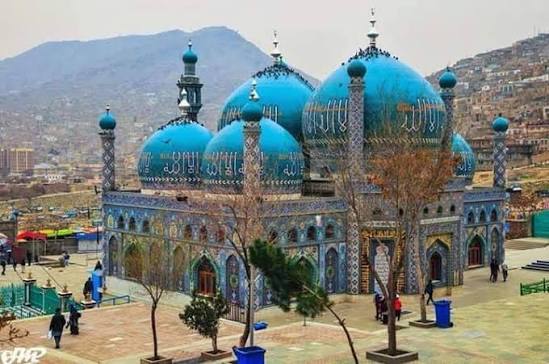
Sakhi Shah-e Mardan Shrine or Ziyarat-e Sakhi is a shrine and mosque located in the Karte Sakhi area of Kabul, Afghanistan. It is associated with the place to which the cloak of the Islamic prophet Muhammad was brought and with a visit from Ali, the son-in-law and cousin of Muhammad, who would later serve as Caliph himself.
The shrine is located at the foot of the Asamayi Hill, now better known as Television Hill. To its north and west is the Sakhi Cemetery.
The shrine is decorated with glazed tiles in a neo-Safavid Persian style. The building bears many inscriptions, including dedicatory texts, Qurʾanic excerpts, prayers, Hadith, and poetry.
It is believed that the shrine marks the spot where the cloak of Muhammad was kept on its way to its present location in the Shrine of the Cloak in Kandahar.
Karte Sakhi is one of Kabul's most vibrant and historic neighborhoods, offering visitors a unique blend of cultural, historical, and spiritual experiences. Dominated by the majestic Sakhi Shrine, this area serves as a spiritual center for many Afghans and is a must-visit for those interested in exploring the local religious and cultural heritage.
10. Habibullah Zazai Park:
Habibullah Zazai Park also known simply as Zazai Park, is an amusement park and a recreation area located east of Bagrami and south of Ahmad Shah Baba Mina in Kabul, Afghanistan. It is named after Habibullah Zazai, the owner and developer of the park.
Zazai park has various rides and provides large walking space with great views of the city. Among the rides, the Ferris wheel, pirate ship and swing ride are the popular ones. The park also has a mosque, an indoor arcade, and places to lounge and eat food.
11. Wazir Akbar Khan Hill:
Wazir Akbar Khan Hill, also known as Tappe Wazir Akbar Khan, is a prominent landmark and park in Kabul, Afghanistan, offering panoramic views of the city and surrounding Hindu Kush mountains. It's located in the affluent Wazir Akbar Khan district, known for its tree-lined streets and well-maintained homes.
The park is a popular spot for locals and tourists alike, offering a green space for recreation, relaxation, and cultural engagement.
Scenic Views:
The hill's elevated position provides stunning panoramic views of Kabul and the surrounding mountains, making it a popular spot for photography and sightseeing.
Recreation and Relaxation:
The Park offers green spaces for picnics, kite flying, and leisurely walks, providing a peaceful escape from the city's hustle.
Historical Significance:
Named after Wazir Akbar Khan, a key figure in Afghan history from the First Anglo-Afghan War, the park has a connection to the area's historical importance.
Cultural Hub:
The Park is a place where locals gather, offering a chance to observe and interact with Afghan culture.
12. The Mahipar Highway: Kabul-Jalabad Road:
The construction of the Mahipar tunnels marked a significant milestone in Afghanistan’s transportation infrastructure.
These tunnels, along with the breathtaking mountainous landscapes surrounding them, have transformed the Kabul-Jalalabad highway into a scenic marvel.
As the planning for the highway began in 1966, engineers and workers faced numerous challenges. The rugged terrain posed obstacles that needed to be overcome to ensure a safe and efficient road for travelers.
The Mahipar mountains, with their towering peaks and rocky slopes, presented a formidable task.
the construction of the Mahipar tunnels on the Kabul-Jalalabad highway has not only improved transportation in Afghanistan but has also added a touch of splendor to the country's landscape.
These tunnels represent a remarkable achievement in engineering and have become a symbol of progress and beauty in Afghanistan.