Ghazni
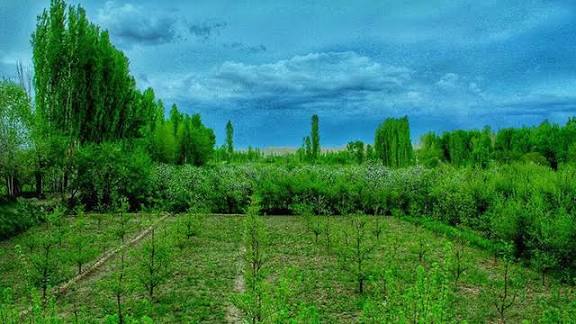
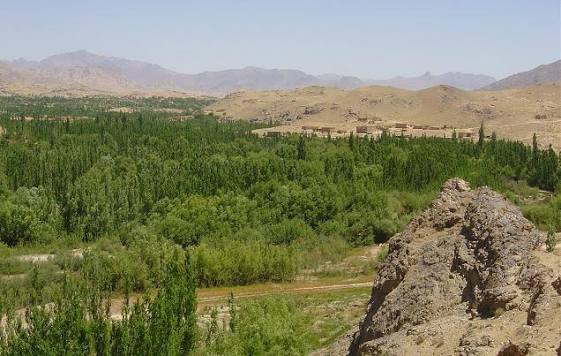
Information Ghazni
Ghazni is one of the 34 provinces of Afghanistan, located in southeastern Afghanistan. The province contains 19 districts, encompassing over a thousand villages and roughly 1.3 million people, making it the 5th most populous province.
The city of Ghazni serves as the capital. It lies on the important Kabul-Kandahar Highway, and has historically functioned as an important trade center. The Ghazni Airport is located next to the city of Ghazni and provides limited domestic flights to Afghanistan's capital, Kabul.
Ghazni was a thriving Buddhist center before and during the 7th century AD. Excavations have revealed religious artifacts of both Hindu and Buddhist traditions.
Ghazni borders the provinces of Maidan Wardak, Logar, Paktia, Paktika, Zabul, Uruzgan, Daykundi and Bamyan.
Get in
If you want to travel from Kabul to Ghazni, take a minibus or shared taxi from the station where vehicles head towards the western and southern regions of Afghanistan.
A seat in a minibus costs 200 AF or 250 AF (~2.70-3.40 USD) and a seat in shared taxi costs 300 Afghani (~4 USD).
It takes approximately 2 to 2.5 hours to drive from Kabul to Ghazni.
See
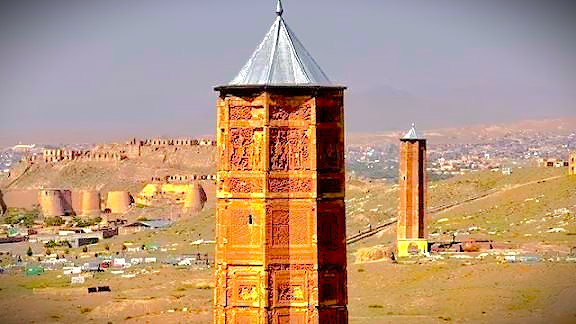
Ghazni minarets
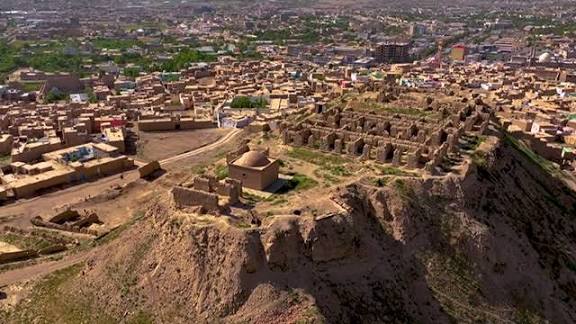
Tomb of sultan Ibrahim ghaznavi
Citadel of Ghazni
Abdul Razaq tomb in Ghazni
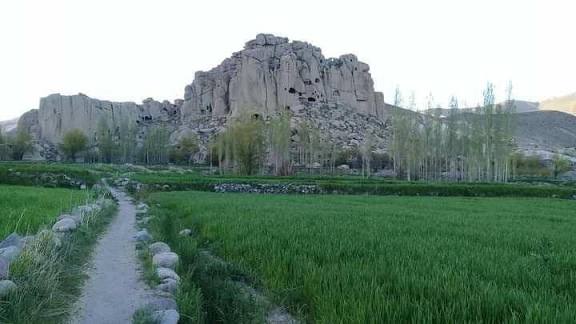
Tepe Sardar Monastery in Ghazni
Tank Museum in Ghazni
1. Ghazni minarets:
The Ghazni Minarets are two elaborately decorated minaret towers located in Ghazni city, central Afghanistan. They were built in middle of the twelfth century and are the only surviving elements of the mosque of Bahram Shah.
The two minarets are 600 meters (1968 feet) apart and lie in an open plain, north-east of Ghazni city.
The minarets had a height of 44 meters in the 19th century, before the top half of both minarets crumbled in an earthquake in 1902. Now the minarets are about 20 meters high. Both minarets of Ghazni are 20 metres (66 feet) tall and built of fired mud brick.
The surface of the towers are decorated beautifully with intricate geometric patterns and Quranic verses on elaborate terracotta tiles. In the 1960s, both towers were fitted with sheet metal roofs in a limited preservation effort.
The ruins of the Palace of Sultan Mas'ud III are located near Mas'ud III's minaret.
The Ghazni Minarets are two ancient towers from the 12th century, built during the Ghaznavid Empire. They stand about 20 meters tall and are decorated with intricate brick designs and Kufic inscriptions.
These minarets once marked the entrance to a grand mosque or palace, but most of the original buildings are long gone.
We drove to the minarets, where you can find the Minaret of Masud III and the Minaret of Bahram Shah.
2. The Tomb of sultan Ibrahim Ghaznavi:
The Tomb of Sultan Ibrahim Ghaznavi is located in Ghazni, Afghanistan, specifically within the Palace of Sultan Mas'ud III. It's situated in the northeastern part of medieval Ghazna, near the tomb of Shaikh Radi d-Din 'Ali Lala.
The area was once a royal palace but later became a cemetery. The tomb is also known as the Ziyara-i Ibrahim.
Here's a more detailed breakdown:
Location:
Ghazni, Afghanistan, within the Palace of Sultan Mas'ud III.
Significance:
It's a site of historical and cultural importance as the burial place of Sultan Ibrahim, who ruled the Ghaznavid Empire for 40 years.
Architectural Features:
The tomb is octagonal on the outside with arched recesses. The interior sepulchral chamber is square. It was originally covered with turquoise-blue tiles, remnants of which can still be seen
Historical Context:
The area around the tomb, originally the palace, was transformed into a cemetery after the palace ceased to be a royal residence.
Other notable tombs in Ghazni:
While Sultan Ibrahim's tomb is significant, the area also holds the tomb of Sultan Mahmud of Ghazni, a powerful ruler of the empire.
3. Citadel of Ghazni:
The Citadel of Ghazni (or Ghuznee, Ghazna) is a large medieval fortress located in Ghazni city, east-central Afghanistan. It was built in the 13th century surrounding the Ghazni town to form a walled city. The 45 metre (147 foot) high citadel dominates the skyline.
The Citadel of Ghazni, also known as Ghazni Fortress, is a historic stronghold that dates back over a thousand years.
It sits on a hill overlooking the city, offering great views and a glimpse into Afghanistan’s past. While much of the structure is in ruins, its towering walls still stand as a reminder of Ghazni’s strategic importance.
4. The tomb of Ulugh Beg II and Abdul Razaq:
The Tomb of Ulugh Beg and Abdul Razzaq at Ghazni Province of Afghanistan.
The 15th Century Tomb of Abdul Razzaq, son of the great astronomer & polymath Ulugh Beg in Ghazni.
The Ghaznavids, a Turkic Empire founded in the 10th Century by Sabuktigin, reached its zenith under his son Mahmud of Ghazni. Fascinating Timurid's heirs would be buried here 500 years later.
5. Tepe Sardar Monastery in Ghazni:
Tepe Sardar, also Tapa Sardar or Tepe-e-Sardar, is an ancient Buddhist monastery in Afghanistan. It is located near Ghazni, and it dominates the Dasht-i Manara plain.
The site displays two major artistic phases, an Hellenistic phase during the 3rd to 6th century CE, followed by a Sinicized-Indian phase during the 7th to 9th century.
The site was excavated by an Italian Archaeological Mission between the late 1960s and the late 1970s, and again in 2003.
Tapa Sardar is the ruin of a large Buddhist stupa - monastery complex which is located four Kilometers southeast of the city of Ghazni. From 1959 to 1977, the complex has been explored by archaeologists of IsMEO.
Tepe Sardar in Ghazni is believed to be an ancient Buddhist settlement during the 7th to 9th centuries from the Kushan Empire.
6. Tank museum Ghazni:
The museum features a collection of military tanks, armored vehicles, and other equipment left behind after the war. They are relics of the military defeat of America and its allied nations.
The exhibition also houses tanks left over from the Soviet Union’s invasion of Afghanistan in 1979-89.
Eat:
In Ghazni a restaurant called (Ghazni Chief Fastfood,) where you can find a variety of dishes with Afghan taste.
Besides, there are many other restaurants nearby, such as the Qanber Burger. I recommend exploring the area and choosing whichever place appeals to you the most.
There are also a few good shops around, perfect for picking up some chocolate, snacks, and drinks.
Sleep:
Taj Continental.
Location: Easily found on Google Maps as Taj Continental.
Breakfast: The breakfast is great—you can have eggs, bread, and tea. You can order extra warm milk to make coffee with the Nescafé if you have with yourself.
The hotel is brand new. The rooms are clean and newly furnished.has Wi-Fi and internet.
Price: 1500 Afghani (~20 USD) per night, including breakfast.
WhatsApp: +93 78 543 4481